Institute of Science Tokyo is accelerating collaboration between medical, dental, and engineering researchers following the university merger. This integration is driving the creation of groundbreaking research outcomes. Co-creation initiatives are already underway in clinical settings and have gained further momentum with the launch of the Institute of Biomedical Engineering (IBE) in July 2025, advancing cross-disciplinary innovation and shaping the healthcare of tomorrow.
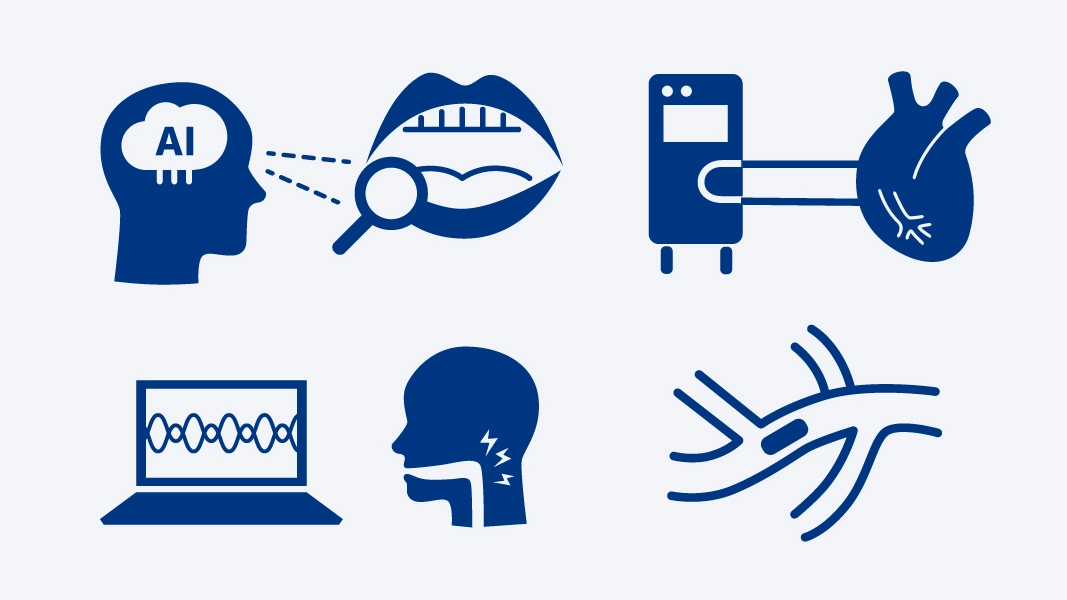
Small data Al for early detection of oral cancer
Oral oncology × AI
In Japan, it is more challenging than in other foreign countries to collect big data due to the difficulty of collaboration among medical institutions. On the other hand, Japanese medical institutions acquire and hold a large volume of high-quality imaging data. Science Tokyo has developed a massive-training artificial neural network (MTANN), an AI technology capable of learning from small datasets. While its performance has already been validated through collaborative research with the National Cancer Center, Science Tokyo, which has the largest number of clinical cases of oral cancer, is now applying MTANN in the field of oral cancer.
Reseachers:
-Professor Kenji Suzuki, Institute of Integrated Research
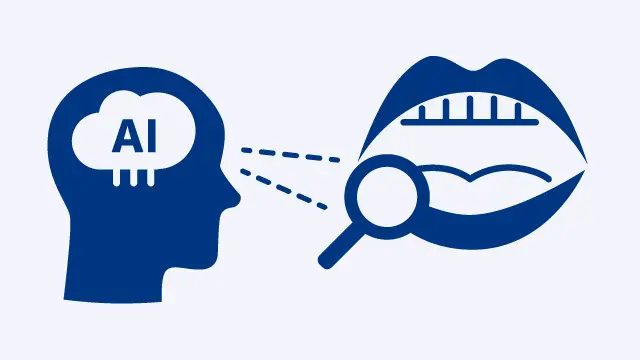
Using magnetism for early detection of dysphagia and heart disease
Geriatric medicine and gerodontology × Magnetics
Through collaborative research between biomedicine and engineering teams, the project team conducted a quantitative assessment of swallowing function using a magnetic test agent. This assessment enables the early detection of dysphagia. Furthermore, a high-sensitivity MR magnetic sensor array is used to enable the measurement of cardiac activity within the hospital to perform non-invasive testing for arrhythmias, as well as risk assessment and early detection of ischemic heart disease.
Reseachers:
-Professor Masanao Inokoshi, Department of Oral Devices and Materials, Graduate School of Medical and Dental Sciences
-Associate Professor Kyohei Okubo, Department of Oral Devices and Materials, Graduate School of Medical and Dental Sciences
-Professor Yoshitaka Kitamoto, School of Materials and Chemical Technology
-Professor Tetsuo Sasano, Department of Cardiovascular Medicine, Graduate School of Medical and Dental Sciences
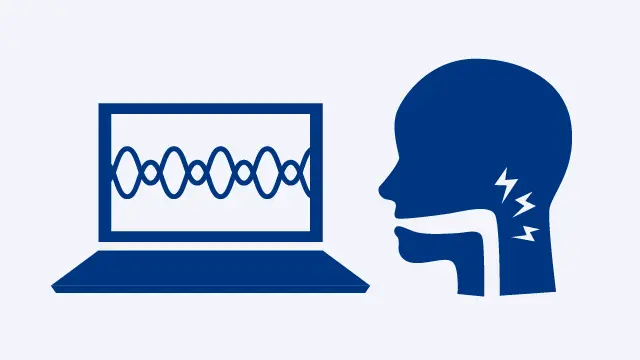
Development of next-generation ECMO equipped with artificial intelligence
Cardiovascular surgery × Mechanical engineering
In response to the strong tendency toward thrombosis observed in patients with severe COVID-19 during the pandemic, the development of a next-generation extracorporeal membrane oxygenation (ECMO) system has begun. This new ECMO incorporates technology to suppress thrombus formation within the circuit by introducing “pulsatile flow,” as well as technology that uses artificial intelligence to estimate a patient’s own cardiac function and automatically adjust support levels. It also features heart rate synchronization control to promote the recovery of the patient’s own heart function.
Reseachers:
-Associate Professor Wataru Hijikata, School of Engineering
-Junior Associate Professor Tatsuki Fujiwara, Department of Cardiovascular Surgery, Graduate School of Medical and Dental Sciences
Development of medical nanomachines for applications from disease detection to treatment
Pathology × Nanoengineering
Smart medical nanomachines, which are nanoscale medical devices equipped with sensors, drugs, and other functions, autonomously patrol the microenvironments inside the body and perform in vivo detection, diagnosis, and treatment. This enables more advanced pathological diagnosis, highly sensitive detection of microcancers, and pinpoint treatment of diseased sites.
Reseachers:
-Professor Nobuhiro Nishiyama, Institute of Integrated Research