Science Tokyo's grand design for the future society
Toward a better future
President and Chief Executive Officer Naoto Ohtake x President and Chief Academic Officer Yujiro Tanaka
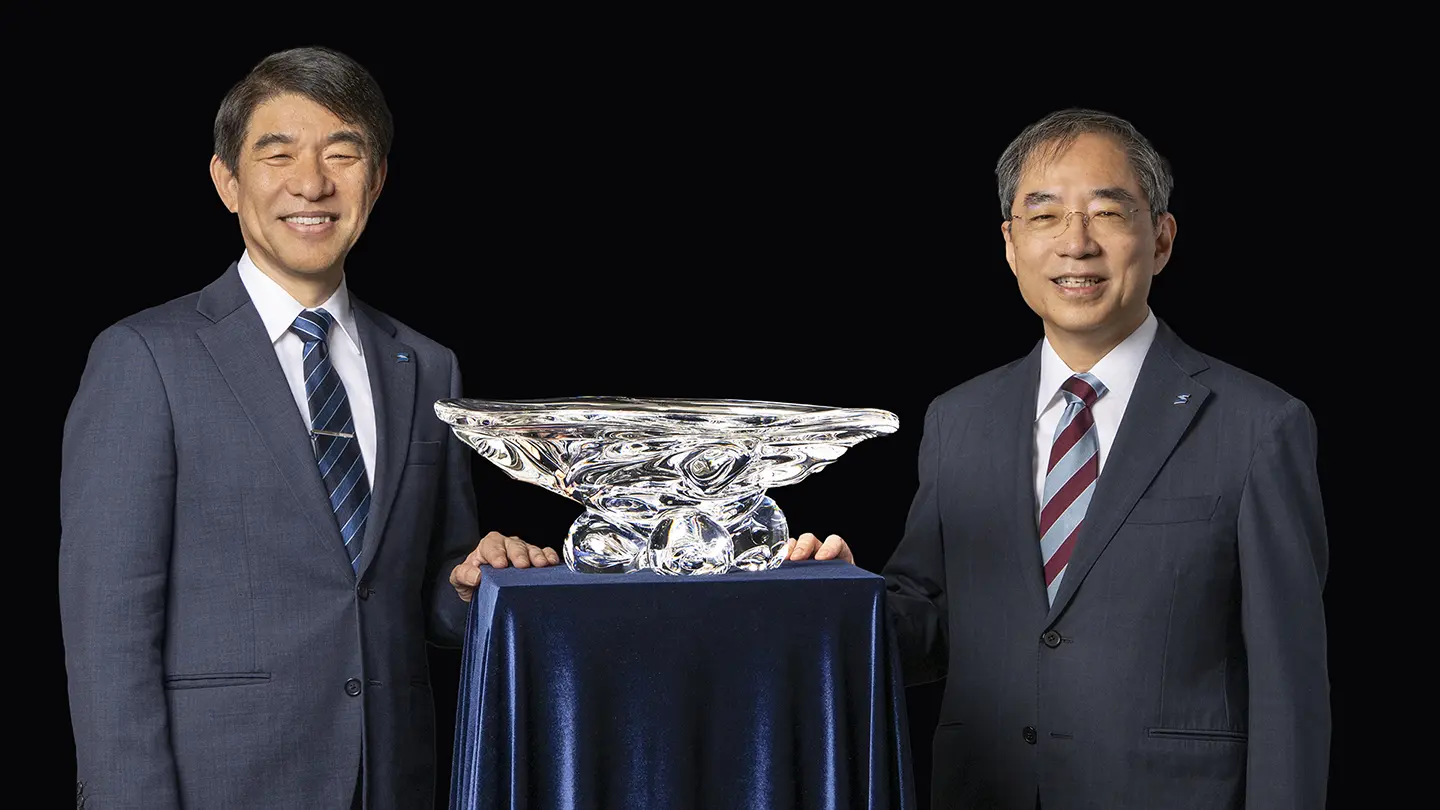
Established on October 1, 2024, through the merger of Tokyo Medical and Dental University and Tokyo Institute of Technology, Institute of Science Tokyo (Science Tokyo) has embarked on its journey toward a better, brighter future under the dual leadership of its President and CEO and its President and CAO. In this conversation, President and CEO Ohtake and President and CAO Tanaka reflect on the Institute's key initiatives since its founding, and discuss their significance and future prospects.
Dialogues cultivating "Our Team" — The true value of Town Hall Meetings
Ohtake Starting with the Konodai Campus on November 12, a total of nine Town Hall Meetings were held across all campuses by December 24. To ensure that the philosophy and significance of the Institute's merger were understood, it was essential to create a forum where the President and CEO, the President and CAO, faculty, and staff could speak candidly across organizational and professional boundaries. In other words, the true merger should begin with people-to-people connections. One of the nine meetings was conducted in English, with a total of 397 faculty and staff members participating. Administrative staff, faculty, and URAs, representing different professions and positions, spoke up very actively.
Tanaka They were very lively, weren't they? Initially, some participants felt that they had no time or that voicing their opinions would make no difference. I made sure to tell them that such feelings often contain important insights for the Institute. I encouraged their participation and called on them to share their thoughts openly. What Dr. Ohtake and I both value is "Our Team, not One Team." In other words, rather than a team where the top simply takes the lead and others follow, it is a team where everyone thinks, struggles, and moves forward together. These meetings were an important first step in building Our Team.
Ohtake Many things left a strong impression on me. For example, hearing earnest concerns such as "Will diversity in research truly be ensured?" and frontline requests like "Provide stronger support for newly appointed faculty members" made me renew my resolve. The exchanges at these Town Hall Meetings are shared with the entire Institute, and specific measures are being considered in response to the requests and opinions. Rather than merely listening and leaving it at that, the Institute takes action to reflect requests and opinions in its actual systems and structures.
Tanaka Many ideas unique to an integrated university emerged. For example, participants expressed interest in collaborating on career support between the science and engineering departments and the medical and dental departments. Others suggested strengthening ties with the Institute's affiliated high school. I felt that the Town Hall Meetings themselves could serve as a new crossroads of knowledge. The greatest realization from these meetings was that the future lies in the voices of those on the frontline. As those responsible for designing systems, there are many realities that we in the executive team seem to understand, but in fact do not. The key to bridging that gap lies in the dialogue at these meetings.
Ohtake Going forward, we plan to hold themed meetings and smaller, department-level meetings. Opportunities for dialogue with students are also being planned. I would like to further deepen the dialogue made possible by the merger. I believe that being a dialogue-oriented university will become the new standard for universities in the future. We will build that model together with everyone involved.
Tanaka Town Hall Meetings are important not only for Dr. Ohtake and myself, but also as an opportunity for members of the Institute to meet and get to know one another. The social gatherings encourage interaction across departments, generating new ideas that lead to co-creation. The voice of each and every member is what drives the Institute forward. Let us continue to engage in sincere dialogue.
Learning and creating together with the world — International collaboration of Science Tokyo
Ohtake The Institute aims to serve as an ecosystem for co-creation with the world. It has entered into agreements and is promoting strategic collaboration with some of the world's leading universities, including the Massachusetts Institute of Technology (MIT; USA), Imperial College London (Imperial; UK), RWTH Aachen University (Germany), and Tsinghua University (China). For example, the Institute engages in educational collaboration with MIT in the field of System Design Management and operates a dual degree program with Imperial. Since the merger, both Dr. Tanaka and I have been actively traveling around the world to advance internationalization in education and research.
Tanaka Reforms are also progressing in education. Before the merger, the Institute had already begun implementing graduate courses taught in English, and such courses now account for more than 93% of all offerings. The Institute is also considering introducing university-wide fall enrollment around 2030, with the goal of achieving an international student ratio of approximately 30%. Behind these efforts is our vision of the kind of individual we seek to cultivate — someone with the ability to carve out a better, brighter future across disciplines and borders. To nurture such individuals, the doctoral program incorporates multidisciplinary instruction by faculty members from different departments, while strengthening education through corporate mentors to advance research, education, and social implementation in an integrated manner.
Ohtake International collaboration is no longer an option—it is the standard. I believe that universities play a vital role in connecting countries and societies. With that awareness, Science Tokyo must work toward positioning itself at the core of the global ecosystem. The Institute also aims to harness the power of science to take on and respond to challenges both in Japan and around the world. To achieve this, "internationalism" — the ability to understand diverse values and act together — must be placed at the heart of the Institute.
Tanaka We will continue to make every effort to nurture talented individuals who will go forth from Science Tokyo to play active roles on the global stage, while creating an educational, research, and living environment that enables us to co-create a better future together with colleagues from around the world. "International education" does not simply mean studying abroad; it means learning together with the world. At Science Tokyo, we place importance on creating an environment where not only Japanese students develop a global perspective, but also students from diverse backgrounds, including international students, learn, discuss, and work together to solve problems.

Social impact created through the integration of medicine, dentistry, science, and engineering
Ohtake The mission of a university is not only to deepen academic knowledge but also to return that knowledge to society. Science Tokyo aims to cultivate the seeds of innovation for a better, brighter future by transforming its hospital and campuses into open hubs of knowledge. In July 2025, the Institute of Biomedical Engineering was established, and the hospital — once a closed medical space — was restructured as a demonstration site for co-creation with companies and startups.
Tanaka Here, researchers in medicine, dentistry, science, and engineering work together in the same space from the very beginning of the research process. The structure in which new research emerges autonomously from the intersection of clinical departments and centers is almost unprecedented in Japan and represents a groundbreaking model. Past achievements of medical–engineering collaboration at Science Tokyo include quantum sensors that detect disease factors in real time, research utilizing small data AI for the early detection of rare cancers, and the development of surgical robots equipped with a sense of touch. The Institute is already engaged in domestic joint research with 17 companies and international collaboration with 8 countries.
Ohtake Our vision for the future of Science Tokyo is to break down the barriers between disciplines and organizations and become an institution that co-creates social impact. To realize this vision, we will continue to advance collaboration between medicine and dentistry and science and engineering, taking on the mission of co-creating outstanding research capabilities and societal impact.
The origins of I4Collective (I4C) — a vision for the future embodied in the phrase "I foresee"
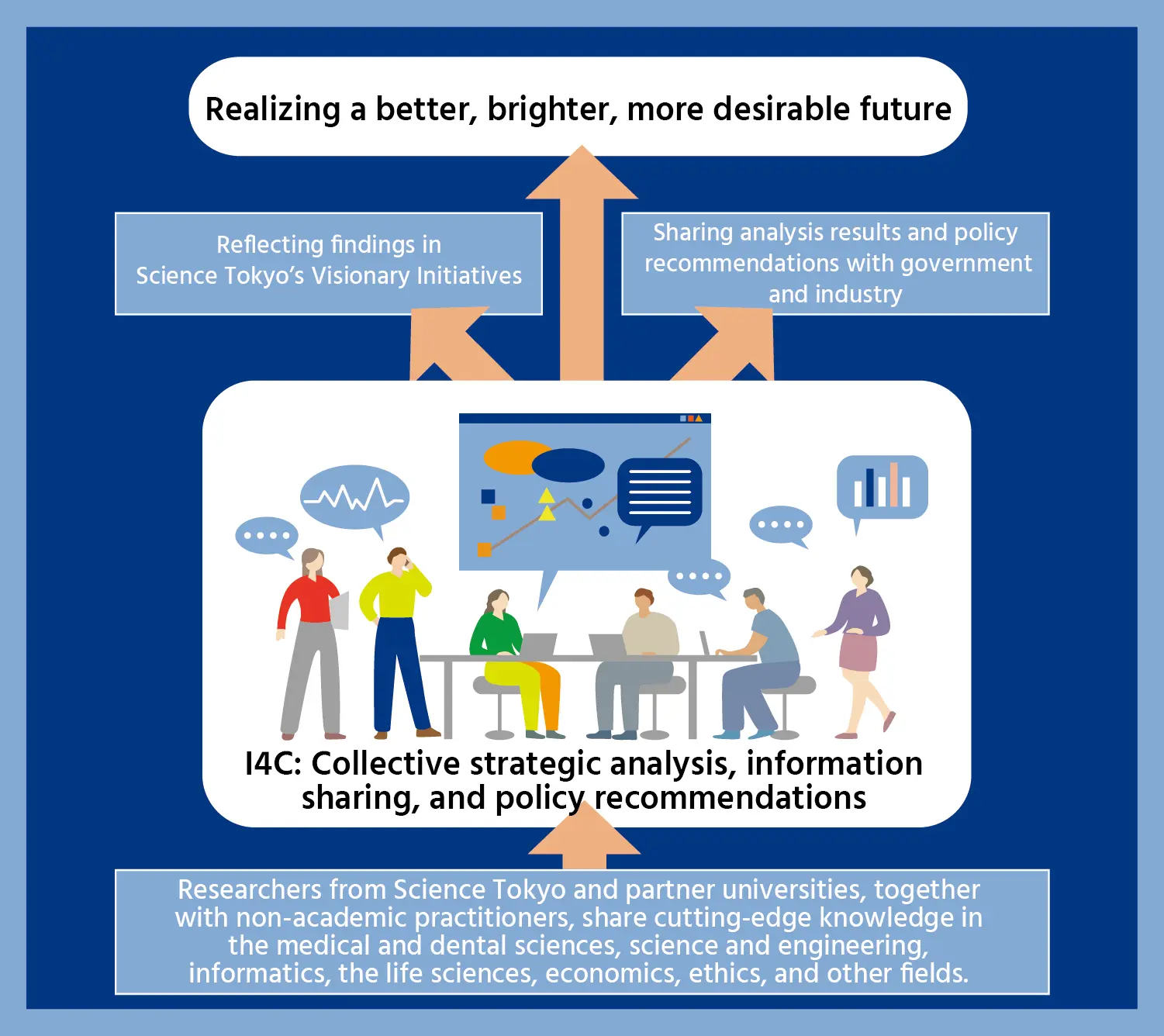
Ohtake On March 1, 2025, the Institute established "I4Collective (I4C)," an organization for analysis and policy recommendations. Positioned directly under the President and CEO, I4C upholds the philosophy of "Investigation with Integrity, Innovation for Impact Collective." As suggested by the origin of its name, I4C is a homophone of the English expression "I foresee." The name reflects a commitment to anticipating the future and formulating forward-looking policies and technology strategies.
Tanaka In terms of anticipating the future and formulating forward-looking technology strategies, I4C is closely related to Science Tokyo's newly-launched concept of the "Visionary Initiatives (VIs)". Unlike traditional discipline-based approaches focused on problem-solving, VIs begin by envisioning the kind of society we aspire to create in the future and the technologies that will be required to achieve it. The next step is to discuss from a strategic perspective the role that Science Tokyo must fulfill in realizing that future, including through external cooperation with industry, academia, and government. As CAO responsible for education, I believe that the insights gained through I4C should be actively applied in discussions on the structure and content of VIs.
Ohtake That's right. For example, in addressing the challenges society will face in the future, it is important to anticipate emerging needs and risks and to propose corresponding technological seeds and policy directions. In other words, rather than simply making predictions, it's essential to present a value-based vision of the ideal society discussed and proposed by VIs, and then to substantiate that vision with I4C's analytical methods, leading to the formulation of concrete policies and the implementation of measures toward realization. The results of this analysis will be shared both in Japan and internationally and will naturally form the core of VIs. This concept is a future-creating initiative that takes a bird's-eye view of the three domains of research, industry, and policy, aiming to maximize the public significance of science and technology. It serves as a core principle that underpins the overall direction of I4C's activities.
Tanaka The impetus for the I4C initiative came from the 2024 National University Management Reform Promotion Project (a project promoted by the Ministry of Education, Culture, Sports, Science and Technology to support the strengthening of university financial bases, reform of university governance, and the restructuring of education and research systems). This wave of university management reform marked a turning point that led to the concept of a next-generation think tank. I would like to actively incorporate the outcomes of I4C into refining the content of the Institute's education and research.
Bridging the gap with science policy — a flexible and open collective
Ohtake The background to the establishment of I4C lies in the structural gap that exists between academia, which is responsible for cultivating human resources in science and technology and conducting specific research projects, and the sectors that plan and implement science policy. In particular, it has been pointed out that insights and awareness from the front lines of scientific research, which operate in an increasingly competitive global environment, are not being adequately reflected in the policymaking process. We established I4C with the aim of strengthening the connection between knowledge and policy, and of delivering to society the practical and future-oriented value of insights from the field.
Tanaka Another distinctive feature lies in the use of the word "collective" in I4C. We deliberately chose this word instead of "Center" or "Research Institute" to express our hope that I4C will be a flexible space where people can gather voluntarily. I've heard that in ancient Greece and Rome, universities originated as "places where knowledge was cultivated," emerging organically from the participation of diverse individuals and lively discussions. It is extremely important for universities to continue to serve as such places today, and I hope that I4C will carry forward this academic spirit.
Ohtake Exactly. While reaffirming the original raison d'être of universities, we also need to redefine their role in modern society. For that reason, I felt it was necessary to clarify the ethical foundations of I4C at the time of its establishment. Science Tokyo's fundamental policy is to assess the impacts of science and technology calmly and to make recommendations from a fair and impartial perspective, grounded in the principles of high ethical standards and social responsibility.
How to connect technology and policy
Ohtake The field of deep tech is particularly well-suited to this initiative. It encompasses cutting-edge technologies developed at universities and research institutes, such as quantum technology, regenerative medicine, and the fusion of AI and robotics. Because these are novel integrations of science and technology, the ethical perspective I mentioned earlier becomes even more important. Moreover, these emerging interdisciplinary fields will form a core that supports Japan's economic security and social sustainability.
Tanaka That's a great point. Many of the research areas our researchers and students are tackling are related to deep tech. However, no matter how advanced or innovative a technology may be, it cannot benefit society without organic connections to people and policy. For this reason, we place importance on conducting swift and effective analysis and making recommendations through close collaboration with leading researchers at the forefront of their fields. This initiative represents Science Tokyo's challenge to take the lead in linking two spheres of knowledge — science and policy — and in envisioning a new social model. As a frontrunner in this effort, I expect I4C to become the intellectual infrastructure for building a better, brighter future.

A network of knowledge that creates a chain effect for transforming society
Ohtake The goal of I4C's activities is not only to analyze the deep tech field and make policy recommendations, but also to create a chain effect of knowledge that extends into multiple domains, including system design, industrial support, education policy, and the development of future leaders. I envision a scenario in which knowledge originating from universities transforms society.
Tanaka It seems that the management structure of I4C is also designed to be interdisciplinary and flexible. I hope to see teams formed that bring together specialists in diverse fields — such as medical and dental engineering, information science, life science, economics, and ethics — to interpret technology from multiple perspectives. Of course, I4C will also focus on building external networks, right?
Ohtake Yes. For example, we plan to promote industrial technology innovation in collaboration with the New Energy and Industrial Technology Development Organization (NEDO); pursue policy partnerships with the National Graduate Institute for Policy Studies (GRIPS) and the Science for REdesigning Science, Technology and Innovation Policy Center (SciREX); and advance international, future-oriented collaboration with policy research institutes around the world as well as with the Institute for Future Engineering, a research institute in Japan that supports the design of future society.
Tanaka In terms of the "chain effect of knowledge," developing human resources who will play a central role in these activities is also an important mission of I4C. For example, I would like to develop programs that provide practical learning opportunities to cultivate think-tank professionals who can operate effectively in the field, not just in theory, through initiatives such as on-the-job training in I4C's analytical activities and collaboration with industry.
Contributing to building a better, brighter future — Toward a trusted evidence hub
Ohtake The better, brighter future we envision is one that people aspire to. Going forward, I would like to see I4C evolve into a highly reliable think tank that serves as a neutral hub for analysis and consistently provides robust evidence contributing to the formulation and implementation of Japan's science and technology policy. Science will remain an essential keyword that forms the core of future Japanese society. I also hope that young researchers and students will look beyond the boundaries of their own specializations and develop a perspective that connects them with society.
Tanaka Through I4C, while believing in the power of science and technology, I also seek to carefully assess their potential risks, with the hope of contributing to the design of a better society.
Related articles
Integrated Report 2025
In addition to financial data, the Integrated Report provides a comprehensive overview of Science Tokyo’s contributions to society, governance, and non-financial information for its stakeholders. The report describes the Institute’s education, research, social initiatives, and management strategies, while charting a course towards further progress.

Interview held on July 8, 2025