How heart failure reshapes bone marrow to create inflammation-related immune memory
Bone marrow stromal cells can link cardiac stress to inflammatory reprogramming
Heart failure (HF) alters the bone marrow (BM), reducing protective cells that regulate inflammation, reports a study conducted at Science Tokyo. According to the study, cardiac stress reduces a population of mesenchymal stromal cells that produces heparin-binding EGF-like growth factor. The resulting reduction in protective signaling alters blood-forming stem cells and promotes inflammatory macrophages. The findings identify the BM niche as an important regulator of lasting immune changes associated with HF, suggesting potential targets for future therapies.
How Bone Marrow (BM) Niche Shapes Innate Immune Memory in Heart Failure (HF)
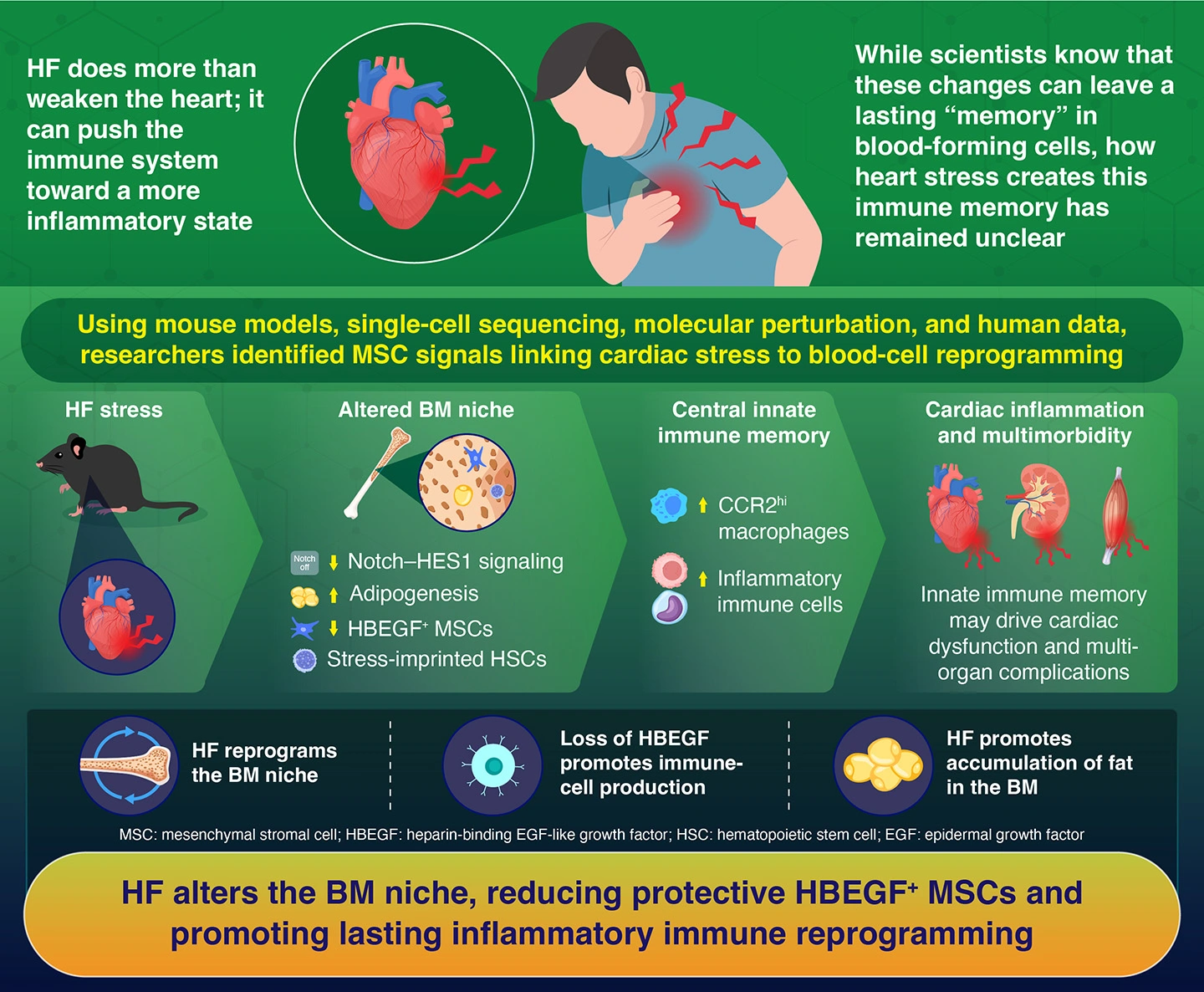
Heart failure (HF) is a condition in which the heart is not able to pump blood effectively. However, its effects go beyond pumping and circulation. HF is also known to cause a lasting form of innate immune memory in stem cells that synthesize blood and progenitor cells that are present in the bone marrow (BM). This can result in the production of immune cells that promote inflammation and worsen heart function. However, the exact mechanism of this process remained unclear.
A research team including Professor Katsuhito Fujiu from the Department of Integrative Physiology, Institute of Science Tokyo (Science Tokyo), Japan, together with Professor Ichiro Manabe from the Department of Systems Medicine, Graduate School of Medicine, Chiba University, Japan; Project Clinical Doctor Kohsaku Goto from the Department of Cardiovascular Medicine, Graduate School of Medicine, The University of Tokyo, Japan (at the time of research); and Project Leader Yukiteru Nakayama from the Tokyo Metropolitan Institute of Medical Science, Japan; together with researchers from Osaka University, Japan; and the International University of Health and Welfare, Japan, set out to fill this knowledge gap. They examined two important BM cell populations in mouse models: mesenchymal stromal cells (MSCs), which support blood cell development, and hematopoietic stem/progenitor cells (HSPCs), which synthesize blood and immune cells. The researchers investigated how interactions between these cells change during HF and contribute to lasting immune alterations. Their findings were published in Volume 17 of the journal Nature Communications on August 26, 2026.
“We combined single-cell RNA sequencing, cell transplantation, molecular perturbation, and analysis of human BM data to investigate how cardiac stress changes the BM niche,” explains Fujiu.
The researchers found that a population of leptin receptor-positive (Lepr+) MSCs in the BM plays an important role in transmitting the effects of cardiac stress to blood cell forming stem cells. Under normal conditions, a subset of these MSCs produces heparin-binding epidermal growth factor-like growth factor (HBEGF), a signaling protein that helps maintain balanced blood cell production. Because of this protective role, these HBEGF-producing MSCs can be thought of as “guardian cells” of the BM niche. However, HF causes reduction of this MSC population and promotes the conversion of MSCs into fat-forming cells (adipocytes).
The loss of HBEGF changes how HSPCs develop. Reduced HBEGF signaling alters the development of HSPCs, pushing them toward producing more myeloid cells and increasing the number of inflammatory immune cells. In particular, the researchers observed an increase in CCR2hi macrophages, a population associated with inflammatory responses in the heart. When MSCs from mice with HF were transplanted with healthy blood cell progenitors, the recipient mice subsequently developed greater cardiac remodeling and dysfunction, demonstrating that altered MSCs can influence hematopoietic cells in ways that affect the heart.
The researchers also identified the mechanism underlying the loss of these protective MSCs. HF suppresses Notch-HES1 signaling in Lepr+ MSCs. This reduction results in increased activity of PPARγ, a regulator of adipocyte formation, helping drive the MSCs toward an adipogenic state. Reducing HBEGF specifically in MSCs similarly promoted myeloid-biased blood-cell production and cardiac dysfunction, supporting a direct role for MSC-derived HBEGF in regulating this process.
The researchers then looked for evidence that this mechanism could also be relevant to humans. They identified a corresponding HBEGF-producing MSC population in human BM. They also found that people with HF had approximately 10-fold higher BM fat than matched healthy individuals.
“Our findings suggest that the changes in the BM environment observed in our experimental models may also be relevant to human HF,” notes Fujiu. However, the obtained human data do not establish that increased BM fat causes HF.
Overall, the BM niche appears as an important component of the central innate immune memory associated with HF. Rather than only acting as a source for blood cells, the BM can respond to cardiac stress by changing its cellular environment, ultimately shaping the immune cells that reach the heart. The study highlights the protective role of the HBEGF-producing MSC population and identifies pathways controlling its maintenance, including Notch–HES1 signaling, as potential areas for future investigation.
Reference
- Authors:
- Kohsaku Goto1, Yukiteru Nakayama1,2,3, Junichi Sugita1,2,4, Tsukasa Oshima1, Kunihito Kani1,2, Atsushi Kobayashi1, Naoto Setoguchi1, Yuxiang Liu2, Yiyi Yang1,4, Jiaxin Ku1,4, Ryoko Uchida1,2,4, Eriko Hasumi1, Takashi Nagasawa5, Issei Komuro6,7, Norihiko Takeda1, Ichiro Manabe8*, and Katsuhito Fujiu1,2,4,9*
- Title:
- Altered bone marrow niche forms central innate immune memory driving cardiac dysfunction
- Journal:
- Nature Communications
- Affiliations:
- 1Department of Cardiovascular Medicine, Graduate School of Medicine,The University of Tokyo, Japan
2Department of Advanced Cardiology, Graduate School of Medicine, The University of Tokyo, Japan
3Stress-imprinted Immunity Project, Department of Clinical Medical Sciences, Tokyo Metropolitan Institute of Medical Science, Japan
4Department of Integrative Physiology, Institute of Science Tokyo, Japan
5Laboratory of Stem Cell Biology and Developmental Immunology, Graduate School of Frontier Biosciences, Osaka University, Japan
6International University of Health and Welfare, Japan
7Department of Frontier Cardiovascular Science, Graduate School of Medicine, The University of Tokyo, Japan
8Department of Systems Medicine, Graduate School of Medicine,Chiba University, Japan
9Department of Biomedical Engineering, Tohoku University, Japan
Related articles
Further information
Professor Katsuhito Fujiu
Department of Integrative Physiology, Institute of Science Tokyo
Contact
Public Relations Division, Institute of Science Tokyo
- media@adm.isct.ac.jp
- Tel
- +81-3-5734-2975