An overlooked electrostatic force drives the motor of the future
Electrostatic forces open the door to low-voltage, rare-earth-free actuation
What the research is about
When we hear about moving objects with electricity, most of us imagine a “pulling force.” Positive and negative charges attract each other, drawing objects together. It is natural to think that this attractive force—known as electrostatic force—is what makes things move.
However, this force is not very strong, and it has not been suitable for driving large machines in our daily lives. For that reason, most practical motors rely on a different mechanism. For example, the motors in electric fans and electric vehicles do not use electricity directly to create motion. Instead, they use electricity to generate magnetic field, and then use that magnetic force to rotate.
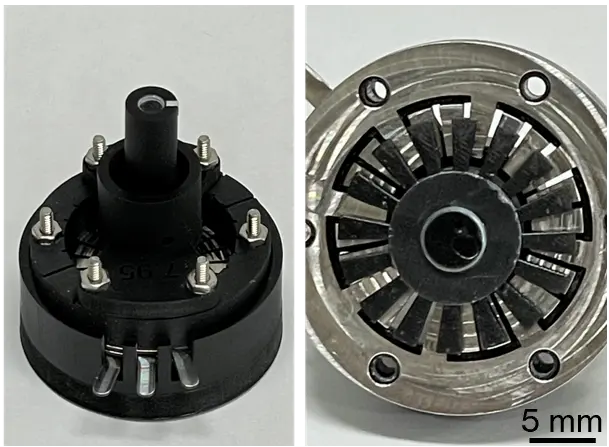
(Image courtesy of Specially Appointed Professor Suzushi Nishimura)
In 2017, however, researchers discovered a liquid that reacts to electric voltage far more strongly than ordinary materials. This material is called a ferroelectric fluid. Using this fluid, devices that previously required dangerously high voltages can operate at much lower voltages.
Importantly, the force generated by electricity is not limited to attraction along the direction of the applied voltage. There is also a force that acts perpendicular to that direction—a sideways pushing force. In conventional materials, this sideways force is extremely weak and has long been considered too small to utilize. As a result, it has attracted little attention.
Why this matters
The most significant achievement of this research is the clear experimental demonstration that this “too weak to matter” sideways electrostatic force can, under the right conditions, become surprisingly strong.
Specially Appointed Professor Suzushi Nishimura and his team at Institute of Science Tokyo (Science Tokyo) focused on ferroelectric fluids and carefully reexamined the sideways force. They placed the fluid between two electrodes separated by only a few millimeters and applied a voltage. The result was striking: the liquid was pushed sideways and moved nearly 10 centimeters even against gravity. When the same experiment was performed with conventional liquids, this motion did not occur. The effect appeared only with the ferroelectric fluid.
Another remarkable finding was how the force increased. In ordinary materials, increasing the voltage does not easily lead to a large increase in force. In contrast, with the ferroelectric fluid, even a small increase in voltage led to a proportional increase in force. The way electricity “works” in this material is fundamentally different.
Through detailed analysis, the team found that the electric field causes the molecules in the liquid to align in an ordered way, generating the sideways pushing force. This insight led to a new idea: if this force can push, could it also rotate?
Based on this principle, the team developed a prototype motor that does not use magnets or a metal rotor. Experiments confirmed that the motor can indeed rotate using this newly harnessed force.
What’s next
This discovery broadens the way we think about motors and actuation systems. Today’s electromagnetic motors require magnets and copper coils. In contrast, this new principle can generate motion without magnets or rare-earth metals. In a world where resources are limited, this is a major advantage.
The structure can also be simpler and lighter. Because the rotating part can be made of resin rather than metal, devices can be made lighter and respond more quickly. This is beneficial for applications in robotics, compact devices, and precision systems.
Moreover, because this motor does not rely on magnetic fields, it may be suitable for environments where magnetic noise is a problem, such as inside medical equipment or data storage devices. Also, it operates at much lower voltages than conventional electrostatic devices, offering improved safety and practical potential.
Comment from the researcher
Our experiments suggested that a motor rotor might no longer need to be made of metal. It sounded hard to believe at first. But when we trusted the data and built a rotor made entirely of plastic, it really did rotate (as shown in the photo at the top of this article).
Interestingly, this force had been theoretically predicted more than 100 years ago, yet no one had ever observed it directly with the naked eye. Becoming the first to witness it was a truly exciting moment. That is one of the great joys of being a researcher. Science is fun!
(Suzushi Nishimura, Specially Appointed Professor, School of Materials and Chemical Technology, Institute of Science Tokyo)

Dive deeper



Contact
Research Support Service Desk